

SPIN WAVES AND MICROWAVE FIELDS
Map fields in space and time
The small dimension of the NV and dielectric nature of diamond make the NV an ideal non-invasive probe for microwave fields. No capacitive coupling and high resolution make it especially useful for miniaturized electronics. With Quantum Lock-in techniques you can separate out specific frequencies. Verify simulations, whether for RF systems-on-chip or ion traps for quantum computing.
Beyond spatial mapping, signals can also be resolved in time. The temporal shape of any arbitrary, replayable signal can be reconstructed with bandwidths of several tens of MHz. Alternatively, arrival times can be determined with significantly higher time resolution. This turns the NV center into an atomic-scale oscilloscope, giving you direct insight into impedance mismatches and the influence of signal reflections on your device.
What to measure?
Microwave fields arise in a wide range of systems, from RF circuitry and ion traps to spin wave devices.
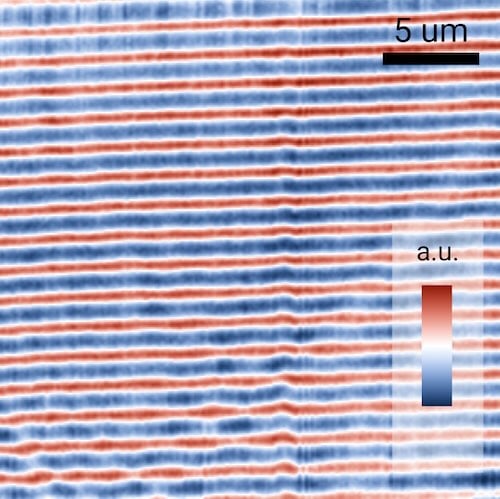
Scanning NV magnetometry has been used to spatially image spin waves in YIG, Simon et al. 2022, with tips fabricated by QZabre enabling high-resolution mapping of spin wave propagation and dispersion.
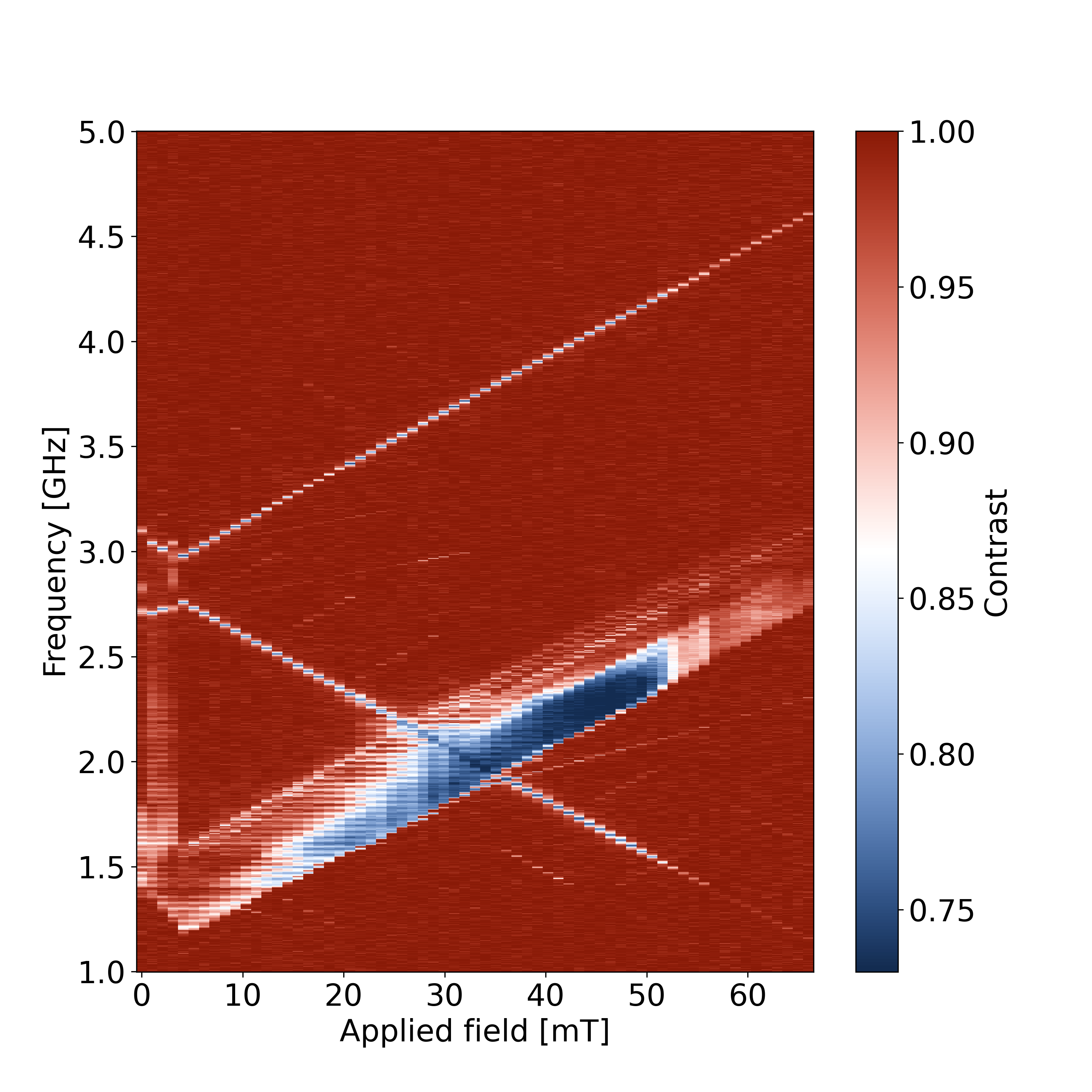
In ferromagnetic samples, NV centers can detect ferromagnetic resonance (FMR) by scanning across both magnetic field and frequency. This reveals the FMR spectrum and provides a quantitative route to measuring sample magnetization.
For time-domain measurements, a recent study demonstrated transient signal reconstruction with a time resolution of 1.1 ns, enabling direct visualization of signal propagation with nanosecond-level timing precision, Herb et al., Nature 2025. These measurements were performed using a QZabre pillar membrane.
How to measure and what are the challenges?
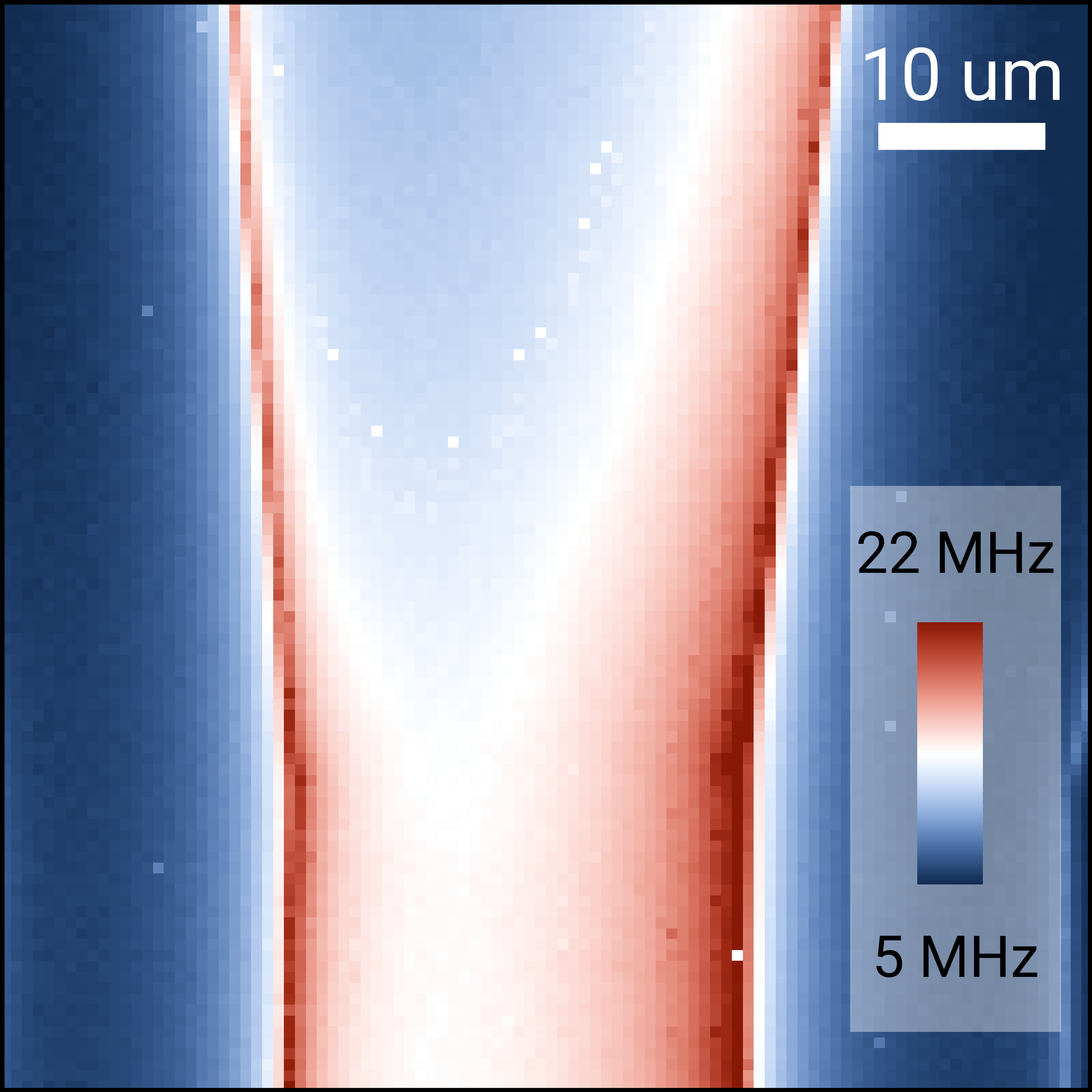
To map RF field amplitude at a target frequency, the NV resonance is tuned into resonance with that frequency by applying a static magnetic field. Covering a large dynamic range therefore requires both a broadband microwave source and a sufficiently large static field.
The QSM addresses both requirements through its NV Advanced Modes extension and Vector electromagnet option.