
Nanoscale NMR
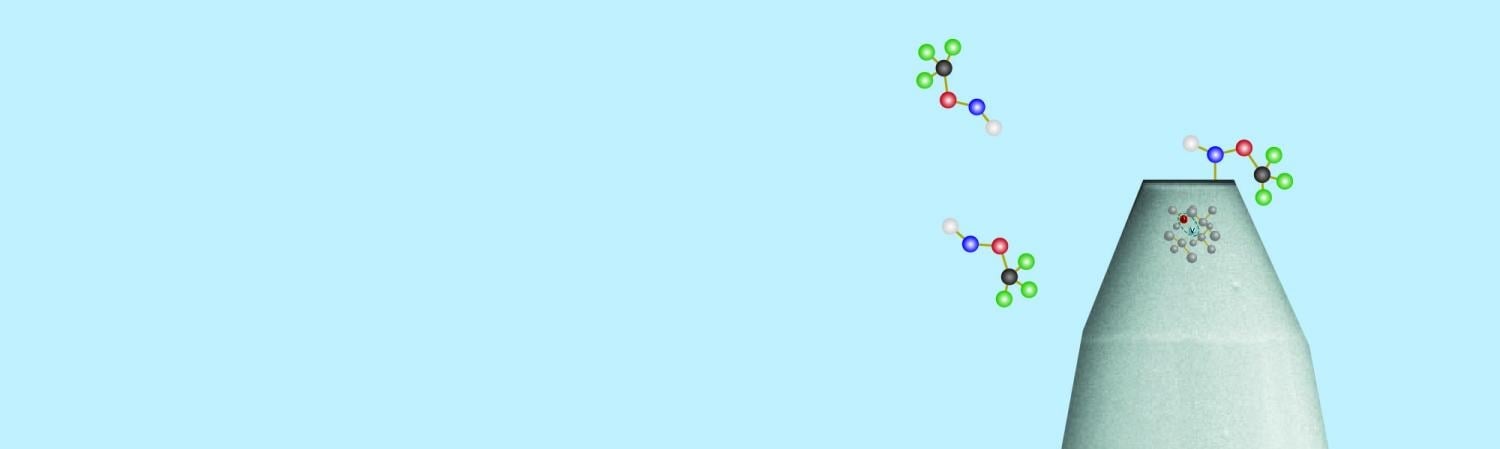
Measure NMR signals of single molecules
NV Depth Calibration
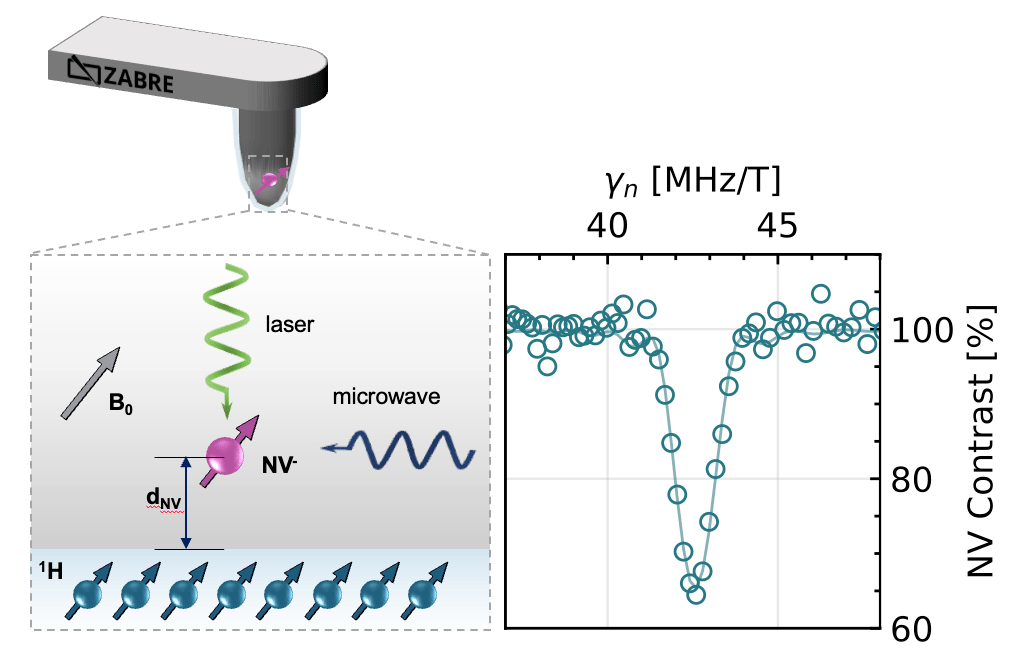
NV depth calibration is one of the key applications of NV-based nuclear magnetic resonance (NV-NMR) spectroscopy. The statistic polarization of 1H spins emanating from the diamond surface absorbed water layer is detected utilizing a CPMG-type dynamic decoupling (DD) spectroscopy. By adjusting the delay τ between the π pulses to half periodicity of the Larmor precession of examined nuclear spins, the magnetic fluctuation, quantified as a root mean square value Brms, can be detected. The NV depth, which correlates with the Brms, is then extracted from an analytic expression

Investigating surface wettability
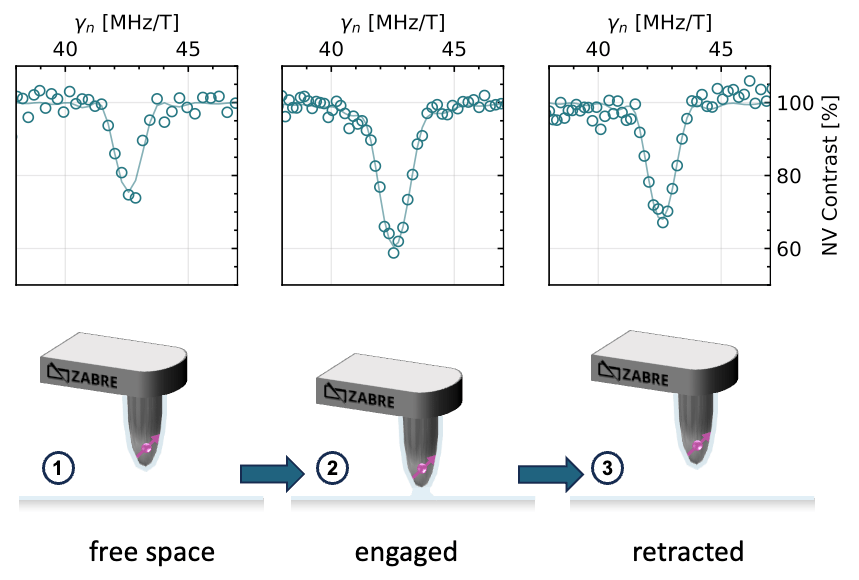
NV-NMR spectroscopy using a diamond probe detects highly localized ¹H signals, enabling nanometer-scale mapping of surface hydrophilicity and hydrophobicity, overcoming the spatial limits of traditional macroscopic measurements. DD spectroscopy further allows direct quantification of nanoscale capillary meniscus formation, yielding high-resolution insights into interfacial wetting and capillary behavior.
The ability to map hydrophilic and hydrophobic domains at such a localized level is critical for developing advanced coatings, anti-icing surfaces, and biocompatible medical implants where surface interactions dictate performance.
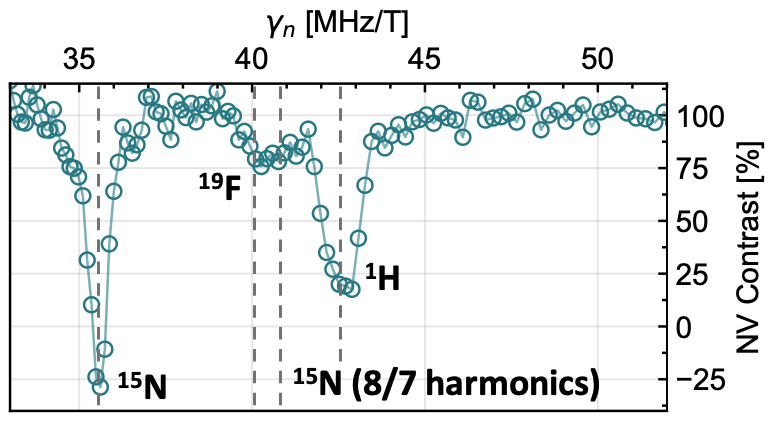
NV-NMR for bio-material, polymers and more
DD spectroscopy with a scanning diamond probe resolves NMR signals at the nanometer scale, broadening NV-based quantum sensing to applications such as biomolecular analysis (DNA, RNA) and the structural characterization of monomers and polymers.
Beyond point-based spectral analysis, multinuclear detection marks a transition from NV-NMR spectroscopy to true nanoscale NV-MRI, translating distinct nuclear signals into spatially resolved images, a powerful mapping capability uniquely achievable with a scanning NV probe.