

CURRENT SENSING AND FAILURE ANALYSIS
Mapping where electrons flow
The way current flows in a device impacts reliability, thermal management and, especially for opto-electronics, performance. Engineers rely heavily on simulations, with almost no tools to verify that they represent reality, especially at the front-end-of-line size scales. Since currents create magnetic fields, we can reconstruct current density maps from the magnetic field maps that the QSM excels at taking. Whether it's localizing defects or detecting current crowding, the QSM will give you data at a size scale and current range that was previously inaccessible.
Get in touch with us to discuss your needs in terms of resolution, sensitivity and other constraints, such as geometry.

Trace Currents at the Nanometer Scale
With a spatial resolution down to 20 nm, determined by sensor-sample distance, and a current sensitivity down to the nA range, scanning NV can trace currents at size scales compatible with the state-of-the-art semiconductor nodes.
Use cases: Design verification and R&D at the FEOL level, high resolution localization of defects in test structures, for example via chains, to accelerate failure analysis.

Image Current Density
Going beyond signal tracing, SNVM creates quantitative images of the current density distribution in the conductors.
Use cases: Determine hotspots and current crowding for improved reliability modelling, verifying simulations and ensuring conductor performance.

Frequency Specific
The QSM can also image AC currents. Even better, the imaging can be frequency specific, allowing an isolated trace of, for example, a clock line, without the background of the DC power delivery and slower logic. Read the details in our IRPS 2024 paper.

Subsurface Imaging
Capping layers and multiple metal levels are not a obstacles. By combining multiple sources of information, such as the current density profile and the AFM topology, we can extract information about the 3D current flow moving between multiple metal layers.
Find faults and verify designs
As integrated circuits grow in complexity, so do the challenges of failure analysis. At modern manufacturing nodes, metal pitches shrink below 40 nm, faster than conventional characterization tools can keep up. Qualitative methods like SEM imaging are often insufficient when precise, nanoscale current mapping is needed.
Scanning NV magnetometry bridges this gap. With resolution fine enough to image Front-End-of-Line features in the most advanced nodes, it can track current paths and overlay them directly onto circuit designs to identify opens, shorts, and defects. AC magnetometry adds further sensitivity by locking onto specific signal frequencies, enabling everything from reliability testing to foundry validation for security-critical applications.
Beyond simple current tracing, scanning NV enables quantitative current density imaging, opening a much wider range of applications:
- Electromigration studies: watch voids grow and quantify how rising current density accelerates failure
- Via chain analysis: assess how close individual vias were to breakdown and their contribution to resistance
- Laser characterization: verify spatial uniformity of current injection into active layers
- Thermal hotspot mapping: understand how current hotspots drive non-uniform thermal profiles and optical distortion

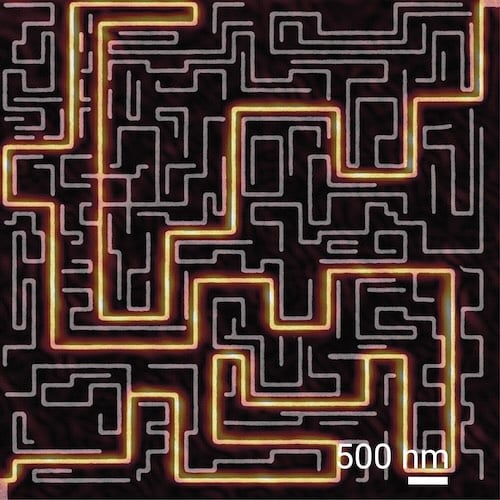
Overlay of SEM image and current density on a set of four identical “maze” structures. Current paths and current densities are clearly discernible. The fourth structure from the left shows a different current flow due to floating lines at the bottom left of the maze. The third structure from the left is defective and does not carry any current, the likely defect is in the top left corner.
How does scanning NV compare to other methods?
With a spatial resolution down to 20 nm, scanning NV magnetometry outperforms optical techniques such as photon emission microscopy by more than an order of magnitude. Compared to widefield NV imaging (quantum diamond microscopy), the scanning approach delivers superior spatial resolution by bringing the NV sensor within nanometers of the sample, unlocking finer current mapping and greater measurement flexibility. Widefield imaging captures an entire field of view simultaneously for higher throughput, but scanning NV provides the resolution and sensitivity needed when fine spatial detail matters. The tightly focused laser and microwave delivery also make it the less invasive option for sensitive devices.
