

PALEOMAGNETISM AND GEOPHYSICS

Reading the record one grain at a time
Natural magnetic minerals lock in the Earth's magnetic field as they form, but not every grain is a dependable recorder. Whether a grain holds a stable remanence depends on its internal domain state, and that is a property of the individual particle. Bulk magnetometry averages over millions of them at once.
The QSM measures the stray magnetic field above a single grain, quantitatively and at 30 nm spatial resolution. Instead of inferring what a population is doing, you see what one particle is doing.
Get in touch to discuss your samples, whether they are FIB-prepared grains, polished sections or loose powder.
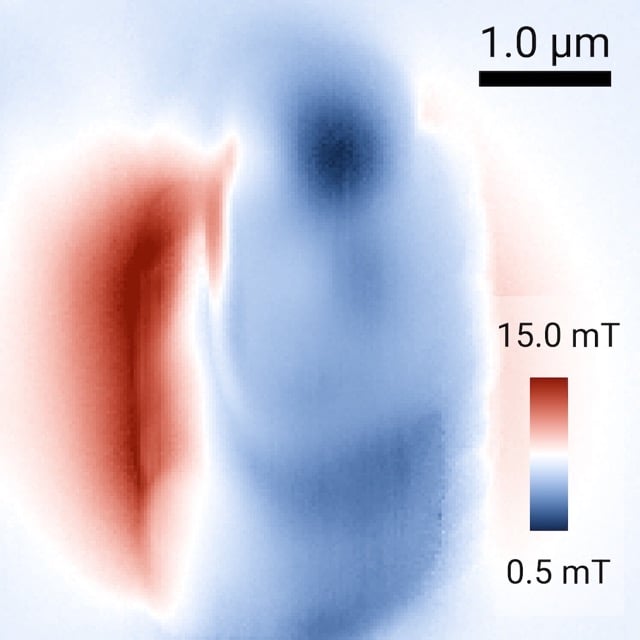
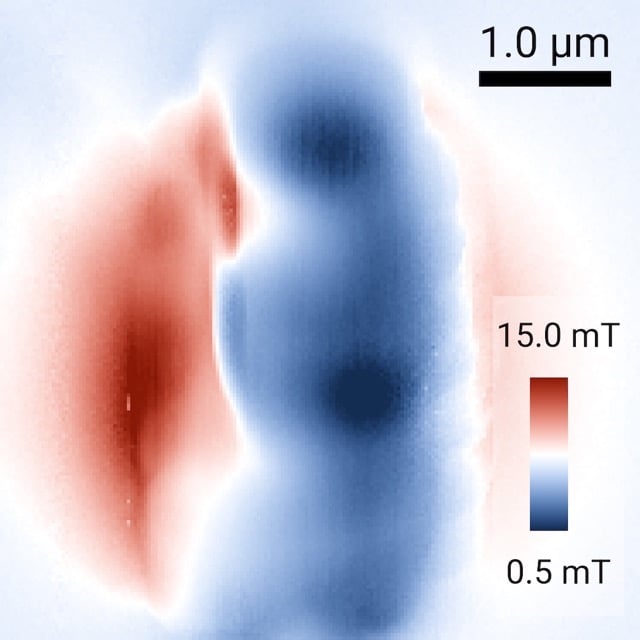
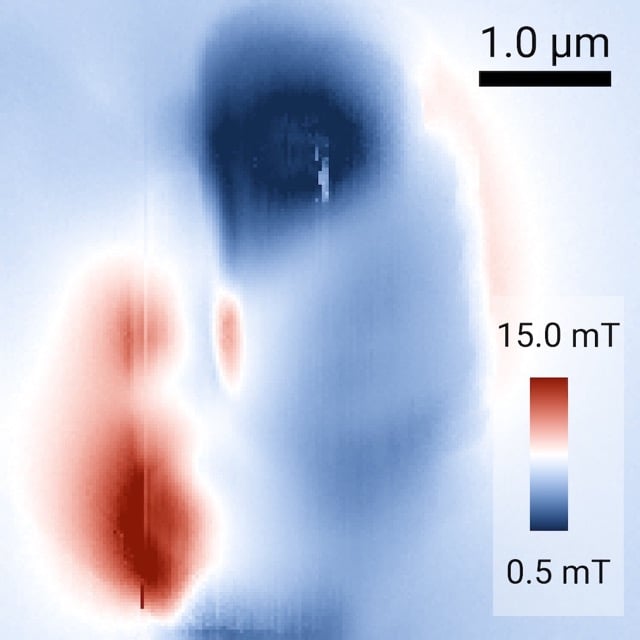
1 µm magnetite grain scans
A pure magnetite grain of roughly 1 µm was isolated from a natural sample by focused ion beam milling, then magnetised along one cube axis at approximately 700 mT. The stray field was mapped by QSM at a stand-off of 300 nm above the sample surface, at 30 nm resolution. The grain was then re-magnetised at 150 mT along the X and Z directions, with a full field map acquired after each step.
Stray fields of order 10 mT were resolved above the grain. Each magnetisation history produced a distinctly different field pattern, consistent with multi-domain behaviour rather than a single uniform moment. This is the level of detail that separates a grain carrying an interpretable remanence from one that does not.
How to measure a single grain?
Sub-micron domain structure is beyond the reach of bulk and widefield methods, grains sit sparsely in a non-magnetic matrix, and contrast-only techniques such as MFM cannot be inverted to a magnetisation. Scanning NV magnetometry addresses all three. The NV center in a QZabre scanning tip is an atomic-sized sensor with a calibrated response, so the output is a magnetic field in physical units, ready for dipole fitting, moment reconstruction or micromagnetic tomography with no separate calibration step.
- 30 nm spatial resolution, set by the sensor-sample distance rather than a diffraction limit
- Quickscan and the NV Advanced Modes Extension locate sparse grains over large areas at up to 200 pixels/s, so high-resolution scans follow only on the grains that matter
- Correlated topography, since the QSM is an AFM: the field map is registered to the grain and the stand-off distance is known (Xu et al., ACS Nano 2025)
- Room temperature and ambient, no cryogenics or vacuum, so the same grain can be removed, treated and scanned again
- Powders and dispersed grains work as well as FIB-prepared single grains, provided the grains are immobilised and the scan surface is reasonably flat. Embedded in resin and polished, dispersed on a flat substrate, or held under a thin capping layer are all suitable. Particles in a dispersion are resolved separately within one scan, mapping a size and shape distribution onto a distribution of magnetic states
Send us a description of your sample and we will tell you what preparation is needed.