

MULTIFERROICS
Why are multiferroics interesting?
Multiferroics are materials that exhibit two or more ferroic orders simultaneously, most commonly ferroelectricity and (anti)ferromagnetism. The coupling between these orders, known as magneto-electric coupling, enables the control of magnetic properties with electric fields and vice versa, offering unique opportunities for low-power spintronic devices and functional sensors. Logic devices made from multiferroics promise to be 10 to 100 times more energy efficient than the current CMOS technology will ever be. The magneto-electric spin-orbit devices avoid what is known as Boltzmann's tyranny for the sub-threshold slope and can also be made smaller (Manipatruni et al, Nature 565, 35-42, 2019). Other applications are low-power reconfigurable antiferromagnetic spintronic devices.
Why are they challenging to measure?
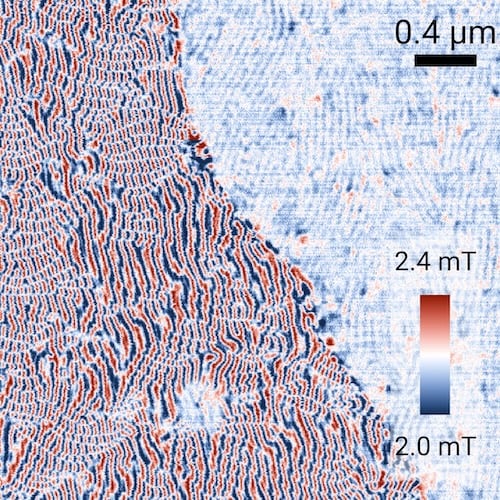
The cycloidal spin structure of BFO produces extremely weak stray fields, making conventional magnetic imaging nearly impossible. High-resolution, quantitative techniques like scanning NV magnetometry are essential to resolve its magnetic domains and correlate them with ferroelectric order.
The QSM is compatible with a variety of different Atomic Force Microscopy (AFM) feedback modes such as amplitude and frequency modulation mode. Tuning the feedback signals and optimising the AFM parameters yields a significant reduction in stand-off distance, enhancing the magnetic contrast of the image. Learn how to minimise the spatial resolution Zhewen Xu et al, ACS Nano 2025, 19, 8.

How to measure multiferroics?
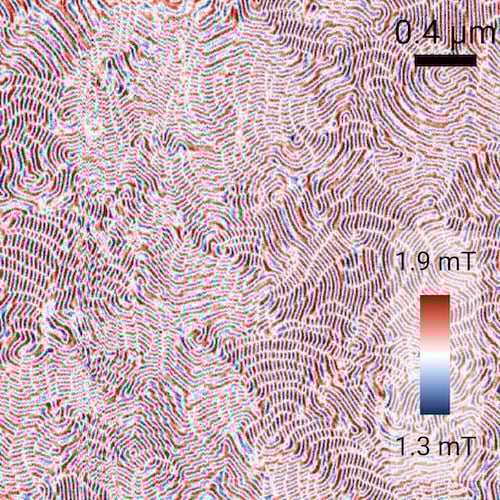
The weak and spatially small (<50 nm) and complex magnetic fields in multiferroics are difficult to probe with conventional techniques. Scanning NV magnetometry provides nanoscale, quantitative imaging of these stray fields, allowing the direct visualization of the spin textures.
The QSM can be complemented with piezoresponse force microscopy (PFM), which measures ferroelectric order. Using NV magnetometry together with PFM allows simultaneous or correlated imaging of magnetic and electric textures within the same multiferroic sample.